
Buyer & Seller: One Store Experience
Replacing 10 Seller tools with one AI-informed workspace - and a service model to match.
Problem
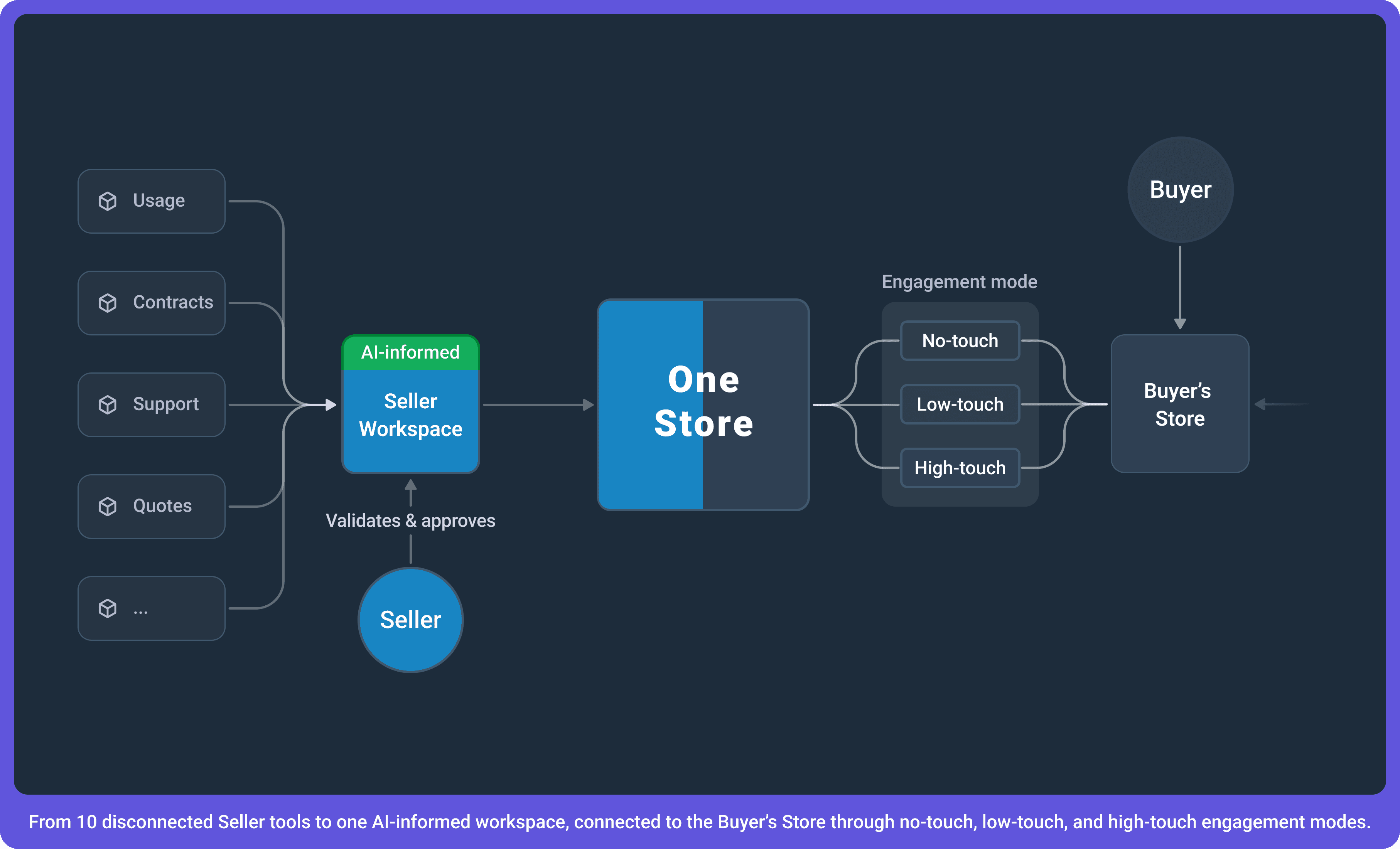
Sellers operated across 10 internal tools. Broken context, manual data transfer, and support overhead meant they spent only 25% of their time selling. Buyers waited. Running this setup cost Dell $40M–$60M per year.
Outcome
SteerCo-approved concept. One Store → Seller Workspace entered the Store domain roadmap.
Role
Senior Product Designer - part of a small, rapid-response vision team. I owned the service model design and the UX/UI for the Seller Workspace.
Timeline
1 month
Vision work commissioned by SteerCo - Dell's senior VPs who fund projects and approve roadmaps. The brief: figure out why Sellers aren't effective, and design a direction the company -can commit to. I designed the service model and the One Store → Seller Workspace - an AI-informed, unified environment replacing 10 disconnected Seller tools. The concept was approved and entered the Store domain roadmap.
one-store-full-tl-dr
Overview
TL;DR
Brief
• SteerCo commissioned the work: unlock Seller effectiveness, reduce cost • Direction given: 10% of clients high-touch, 90% no/low-touch - make it work • Small team, tight deadline, strategic output - not a product sprint
What I designed
• A 3-tier service model across the full Seller journey - from the given direction into a working, approvable structure • One Store → Seller Workspace: the materialization of that model - a single AI-informed environment replacing 10 tools
Impact
• Concept approved by SteerCo - entered the Store domain roadmap • Estimated $40M–$60M annual cost-saving opportunity • Target: Sellers spend 90% of time selling, post-implementation
one-store-cardsx3
Numbers
Target architecture
10 → 1
Internal Seller tools replaced by the One Store → Seller Workspace
Seller effectiveness
25% → 90%
Target shift in Seller time spent on selling
Estimated impact
$40M–$60M
Estimated annual cost-saving opportunity
one-store-strategy
Strategy
This is not classic product work
Most product design work follows a familiar path: define the problem, explore solutions, test, ship, measure. This was different.
SteerCo commissioned a small team to address one of the biggest structural problems in the Store domain. The output was not a feature or a flow - it was a strategic direction the company could fund and build toward. The team included a Sr. Lead Principal UX Architect, Store business lead, process engineer, and me as Senior Product Designer. I owned the service model design and the end-to-end UX and UI for the One Store → Seller Workspace.
one-store-full-service-model
Logic
The service model
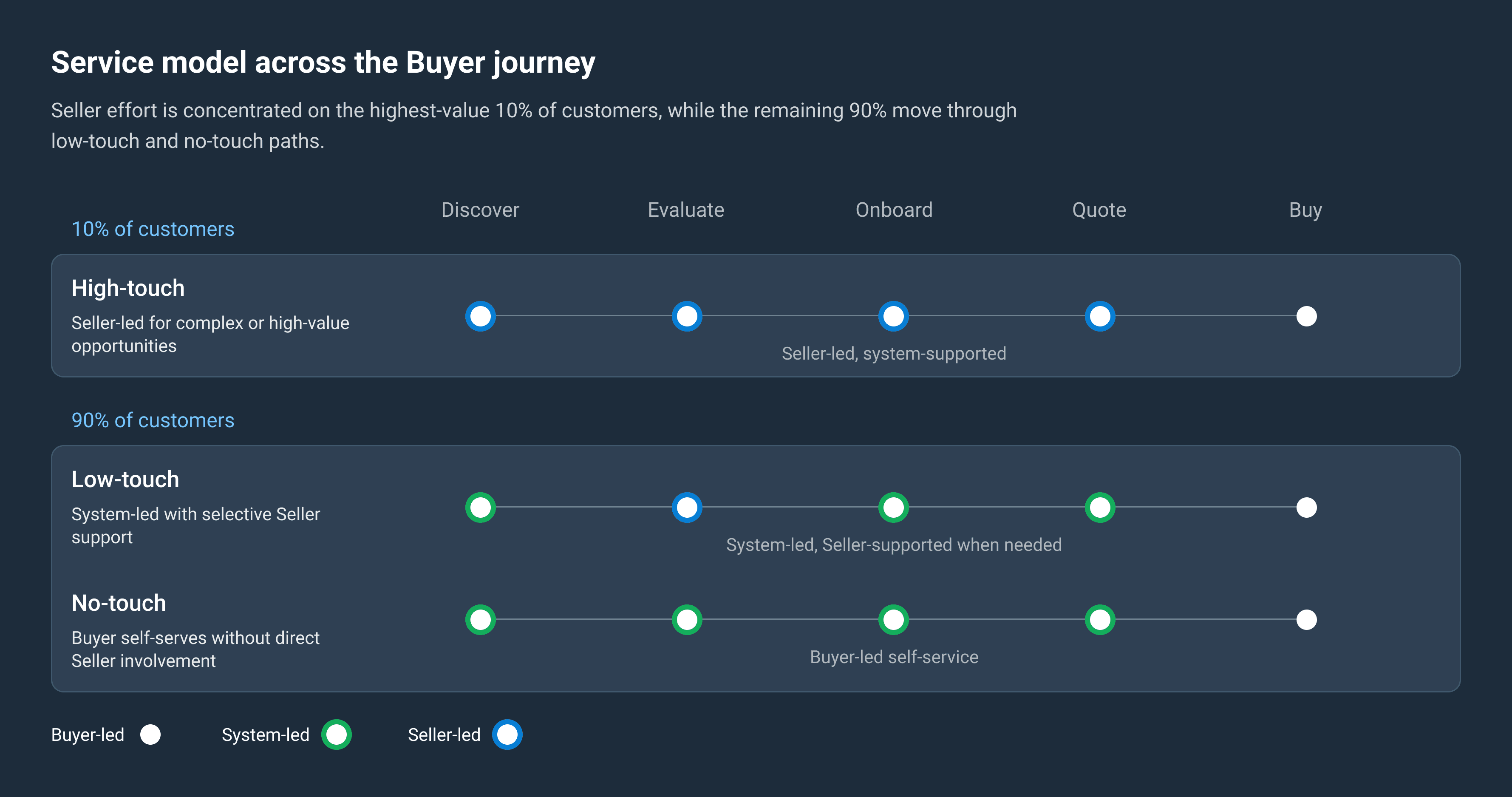
The brief gave us a direction: only the highest-value accounts should get real Seller time. Most interactions should be handled without direct Seller involvement. Figure out how.
I took that direction and designed a working structure - not just a segmentation, but a model that mapped Seller effort to Buyer value across every stage of the journey.
No-touch - Buyer self-serves entirely. No Seller involvement unless requested.
Low-touch - AI handles routine interactions. Seller is notified only when signals suggest an opportunity.
High-touch - Seller engages directly with full context. Reserved for complex, high-value accounts.
The model needed to be embedded in the product - visible in the UI, not just in a diagram.
one-store-full-design
Design
One Store → Seller Workspace
The Seller Workspace is where the service model becomes product.
Before: a Seller checked 10 separate tools to find signals, context, and opportunity for each account. Most of it was noise. Important signals were easy to miss. None of it connected to what the Buyer was doing in the Store.
I designed one AI-informed environment to replace all of that - guiding the Seller toward the right accounts, at the right time, with the right recommendation. Without making decisions for them. Engagement mode stays a Seller decision - the system informs it, not dictates it.
one-store-full-design-screens
Callouts
The Experience
The experience is organized around five capabilities:
Prioritized opportunities
AI collects signals across all 10 data sources and builds a prioritized list - with context on why each account surfaced and what the system recommends. The Seller decides what to act on.
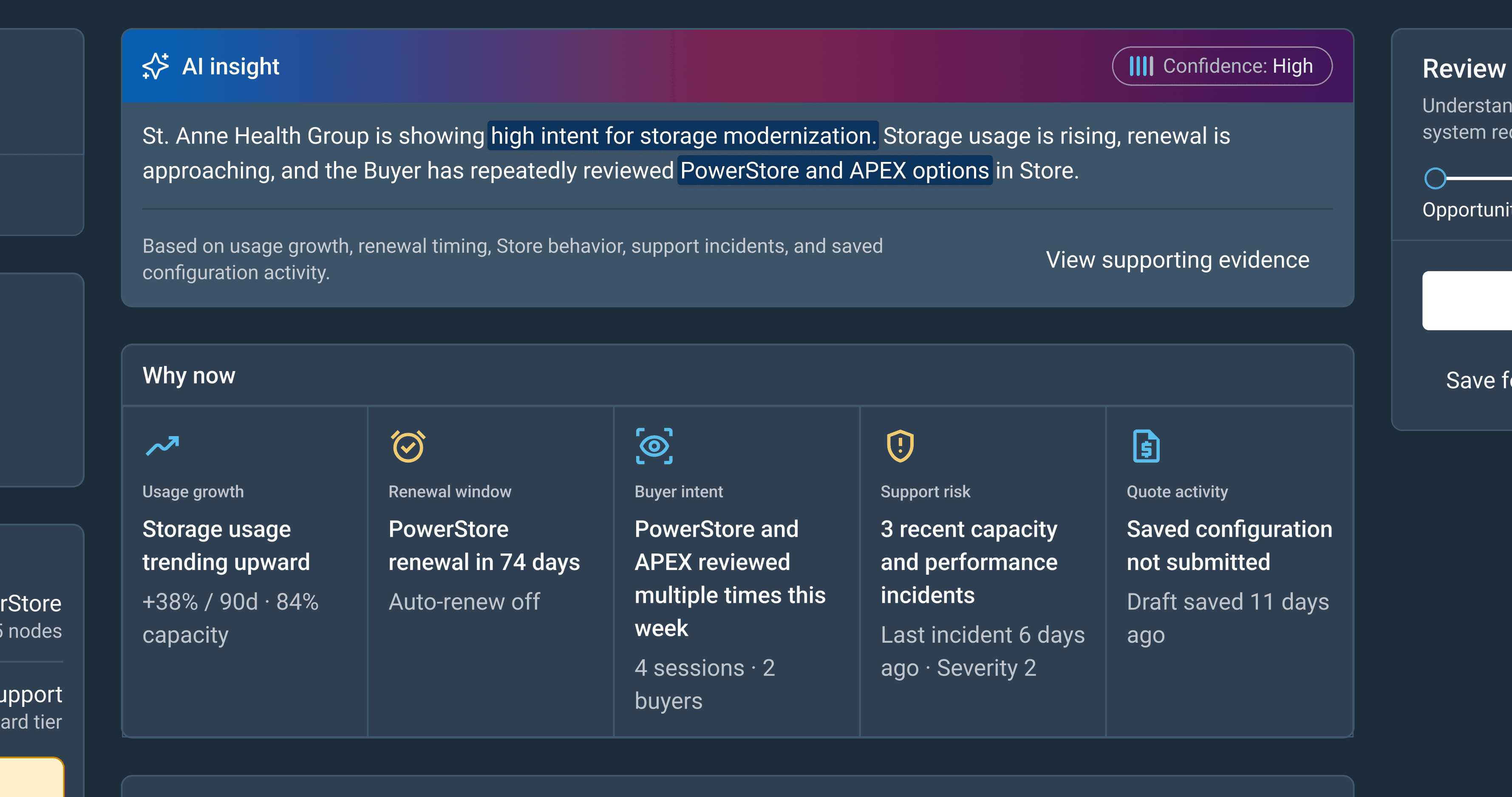
Evidence and validation
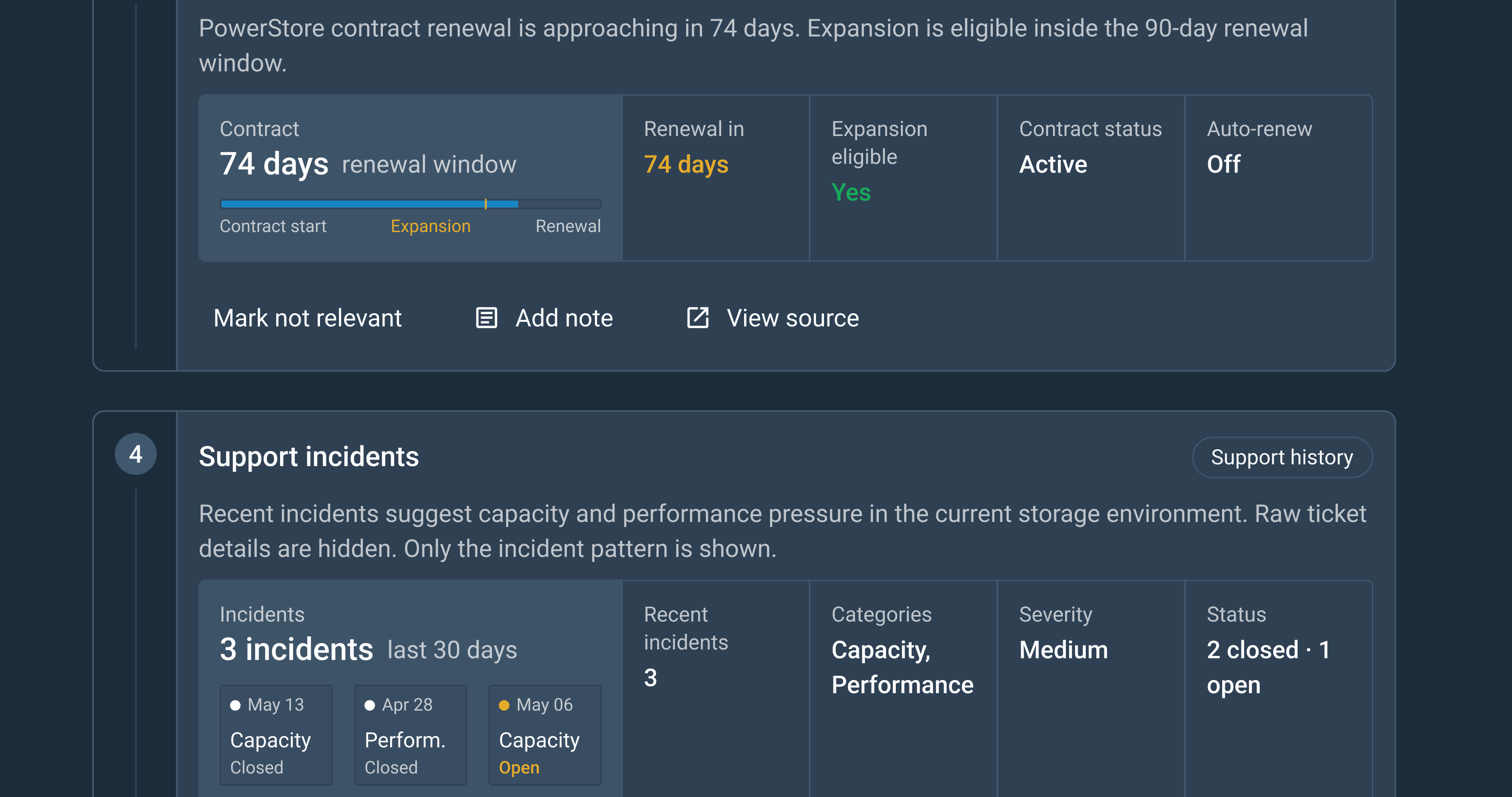
Signals from account activity, Store behavior, support history, contracts, usage, and quotes - all in one place. The Seller can validate, dismiss, view the source, or add context the system will use to refine the recommendation.
Recommendation preparation
AI pre-loads the recommendation. The Seller edits and approves everything. Buyer-facing content and internal Seller notes are kept separate - the Buyer never sees internal reasoning.
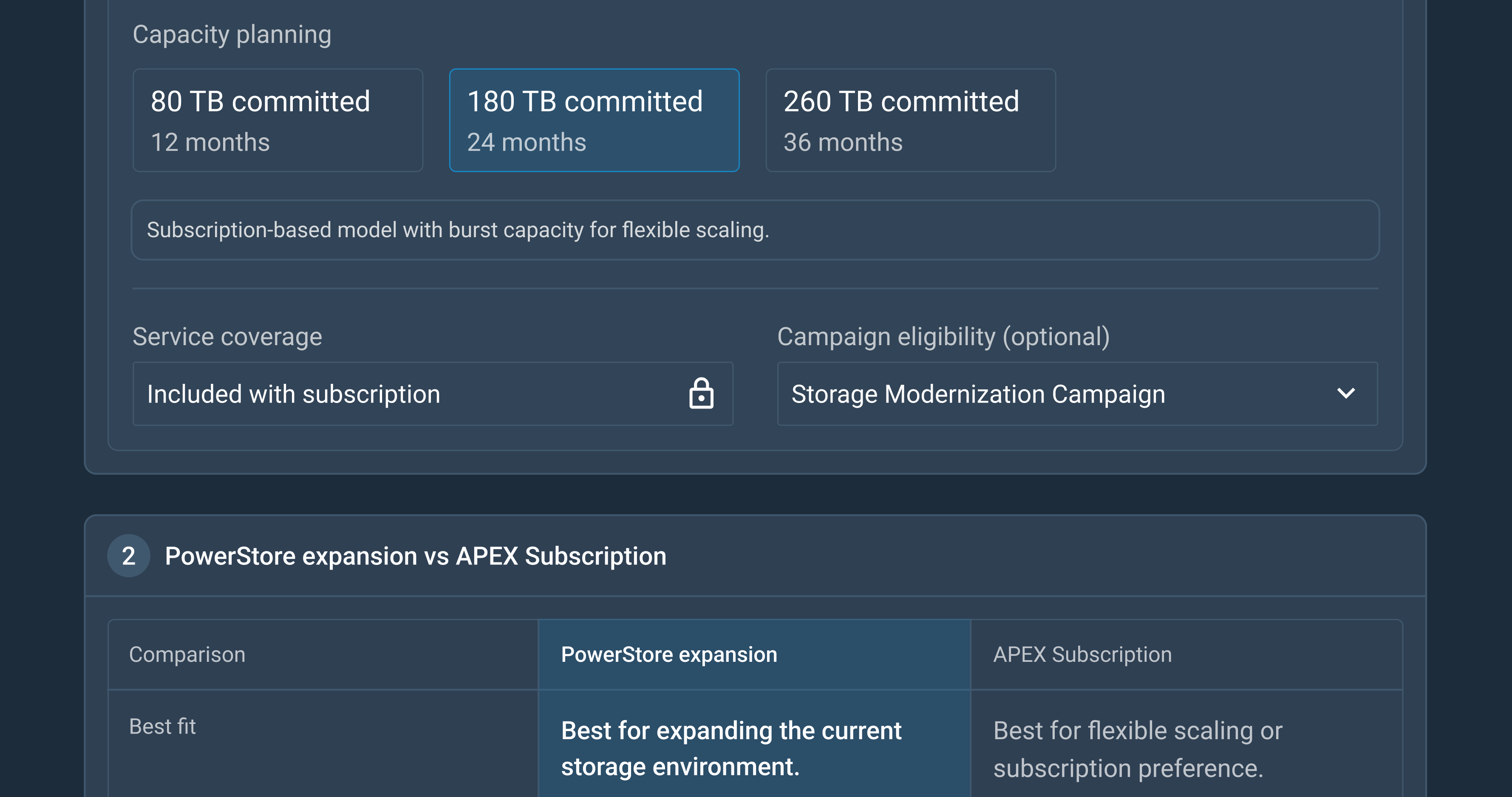
Buyer preview
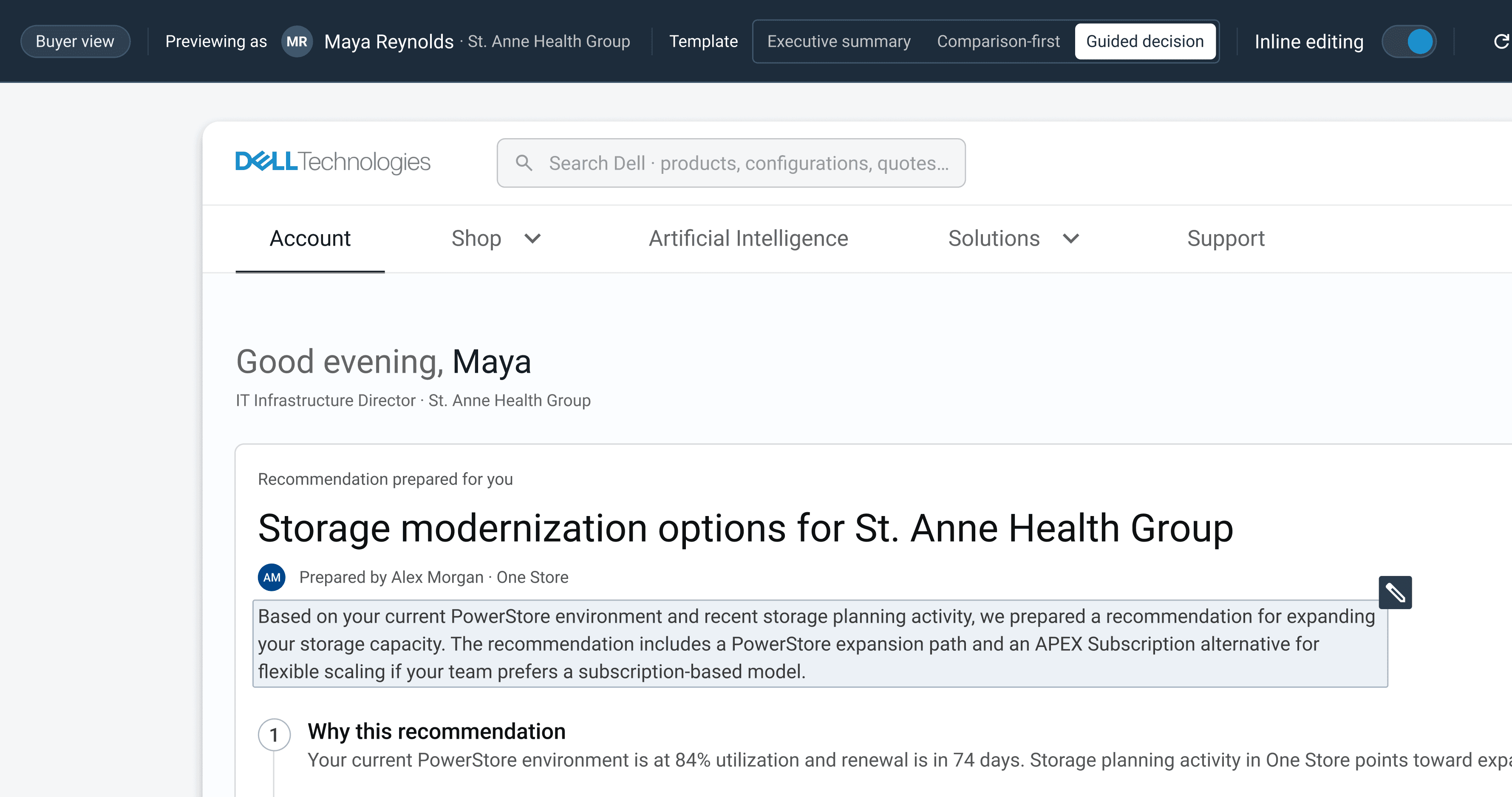
The Seller sees exactly what the Buyer will see - inside the Buyer's actual Store. Using WYSIWYG capabilities brought from the Content lane, inline edits are possible directly in context. The Seller approves the view before the Buyer ever sees it.
Engagement mode
The Seller chooses how the Buyer receives the recommendation: • No-touch: Buyer self-serves, no meeting • Low-touch: recommendation sent asynchronously • High-touch: shared Store session scheduled
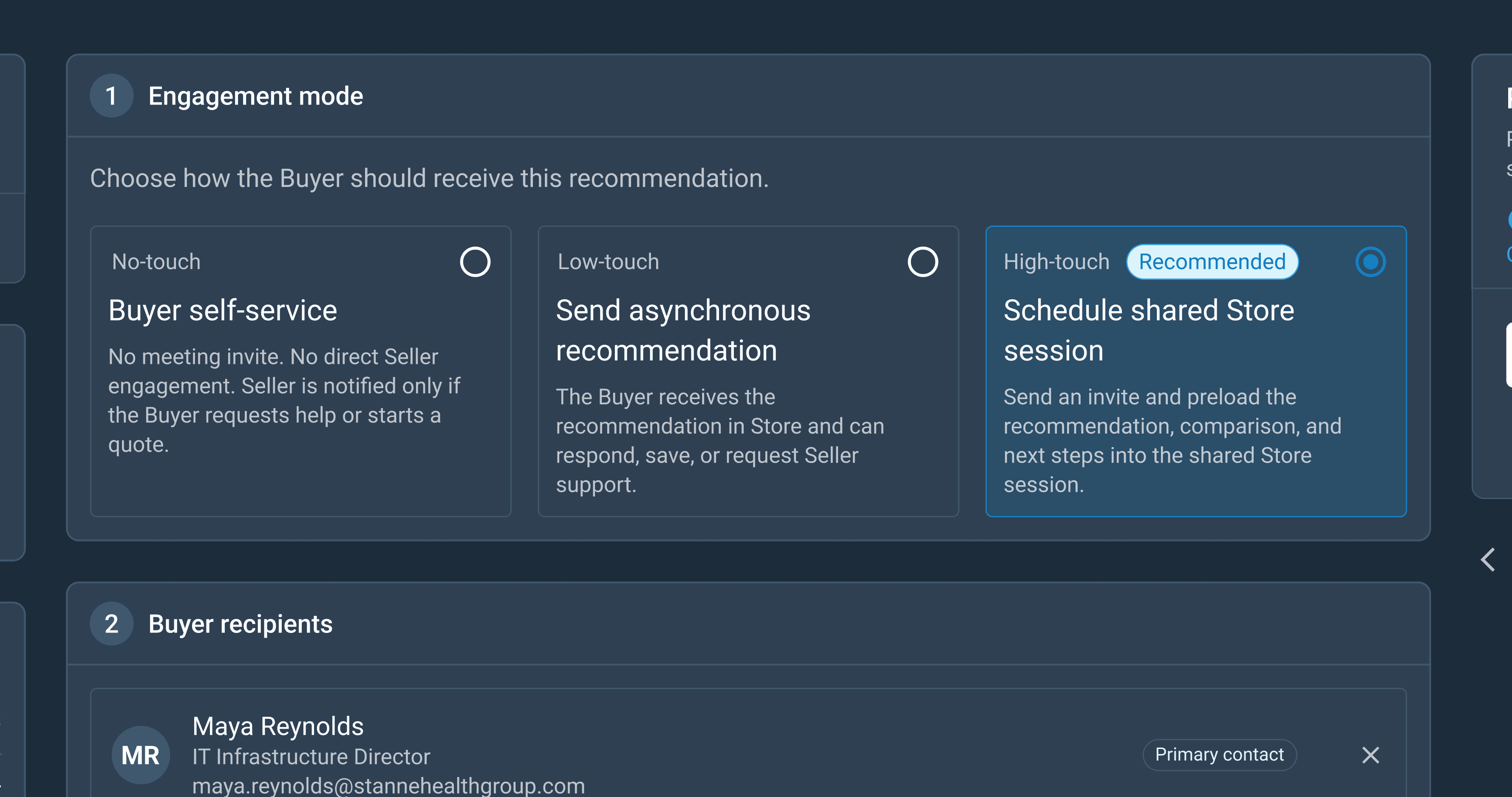
This screen is where the service model is directly visible in the product. The engagement mode is not a setting - it is the service model, embedded in the decision the Seller makes for every opportunity.
one-store-outcomes
Impact
Outcomes
SteerCo approved the One Store → Seller Workspace concept
Work entered the Store domain roadmap - dev teams building it now
No full platform rebuild required - implemented as an extension of the existing Store
The $40M–$60M annual cost-saving estimate was scoped by the VPs who commissioned the work, based on the cost of running the current 10-tool Seller setup - not realized savings.
Target: Sellers spend 90% of time selling, post-implementation
Case study
Highlights