
From SKU Codes to Configurable Offers
Enabling configurable multi-component subscriptions on Dell Premier.
Problem
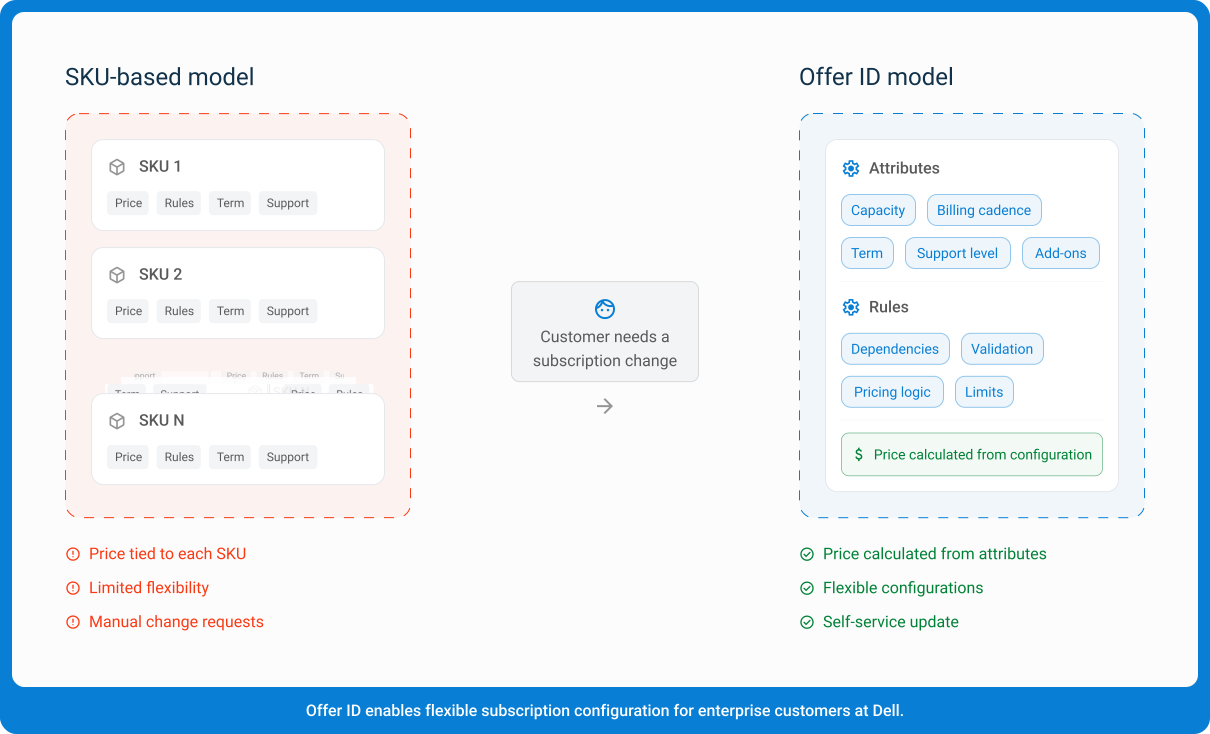
Dell Premier ran on a SKU-based model. Every subscription change required emails, sales rep calls, and manual pricing. What should have been a product interaction was a multi-day operational process.
Outcome
Subscription management time moved from up to two weeks to under 11 minutes. Self-service adoption moved from 0% to confirmed targets met across Phase 1 and Phase 2.
Role
Senior Product Designer - sole designer on the team. End-to-end UX and UI.
Timeline
Q2 2024
I designed and shipped the first Offer ID-based subscription flows on Dell Premier - moving business customers from manual, rep-dependent processes to fully digital self-service.
sku-full-tl-dr
Overview
TL;DR
Problem
• SKU codes tied price to a fixed product code - no flexibility, no self-service • Every change required a sales rep, emails, and manual pricing • Procurement managers at thousands of Dell business customers globally were affected
Solution
• Designed the end-to-end mid-term configuration flow for the first Offer ID-based offers • Translated raw business requirements into structured, buildable offer models • Documented edge case rules for engineering before implementation began • Ran UserTesting sessions to validate key flow decisions
Impact
• Subscription management moved from 5-7 business days to under 11 minutes • Self-service adoption moved from 0% to confirmed Phase 1 and Phase 2 targets met • Engineering built backend logic directly from scenario diagrams I produced • End of Contract flow team reused the extracted rules without starting from scratch
sku-full-cardsx3
Metrics
By the numbers
TTV (Time to Value)
5-7 days → 6-11 min
Subscription management time for mid-term, multicomponent workflows. Before: 5-7 business days (direct) or 1-2 weeks (partner). After: 6-11 minutes, measured in real sessions at client offices.
Feature Adoption
0% → confirmed
Self-service adoption for mid-term, multicomponent subscriptions. No self-service existed before. Phase 1 (US & Canada, small businesses) and Phase 2 partner scenario both confirmed successful.
hardest design decision
70%
70% of Dell business customers have a dedicated License Manager, separate from the Procurement Manager. This finding drove the most consequential structural design decision in the mid-term flow.
sku-full-system-logic
System logic
From business requirements to buildable logic
The BTO (Business Transformation Officer) provided subscription definitions - thorough documents written from a business perspective, not a product one. They described what the system should do.
They didn't specify:
What belonged in the UI versus the backend
How rules should behave when conditions conflicted
What edge cases needed explicit handling
Translating those definitions into structured, buildable offer models was the core of my work.
One example: the BTO stated customers could schedule a subscription change. Working through the definition, I identified a constraint it didn't flag - a customer can only have one active scheduled change at a time.
That single rule had direct consequences for the UI:
Surface any existing scheduled change before allowing a new one
Handle the case where a user tries to create a second
Communicate the constraint without making the customer feel blocked
I didn't wait to discover conflicts like this during build. I mapped scheduled change scenarios systematically - starting states, combinations of immediate and future changes, what would pass and what would fail at execution - and brought them to the PM and architect before implementation. The engineering team used those diagrams as a technical reference. That wasn't the original plan. It reflects how much ground was left between the BTO's definitions and what the team needed to build.
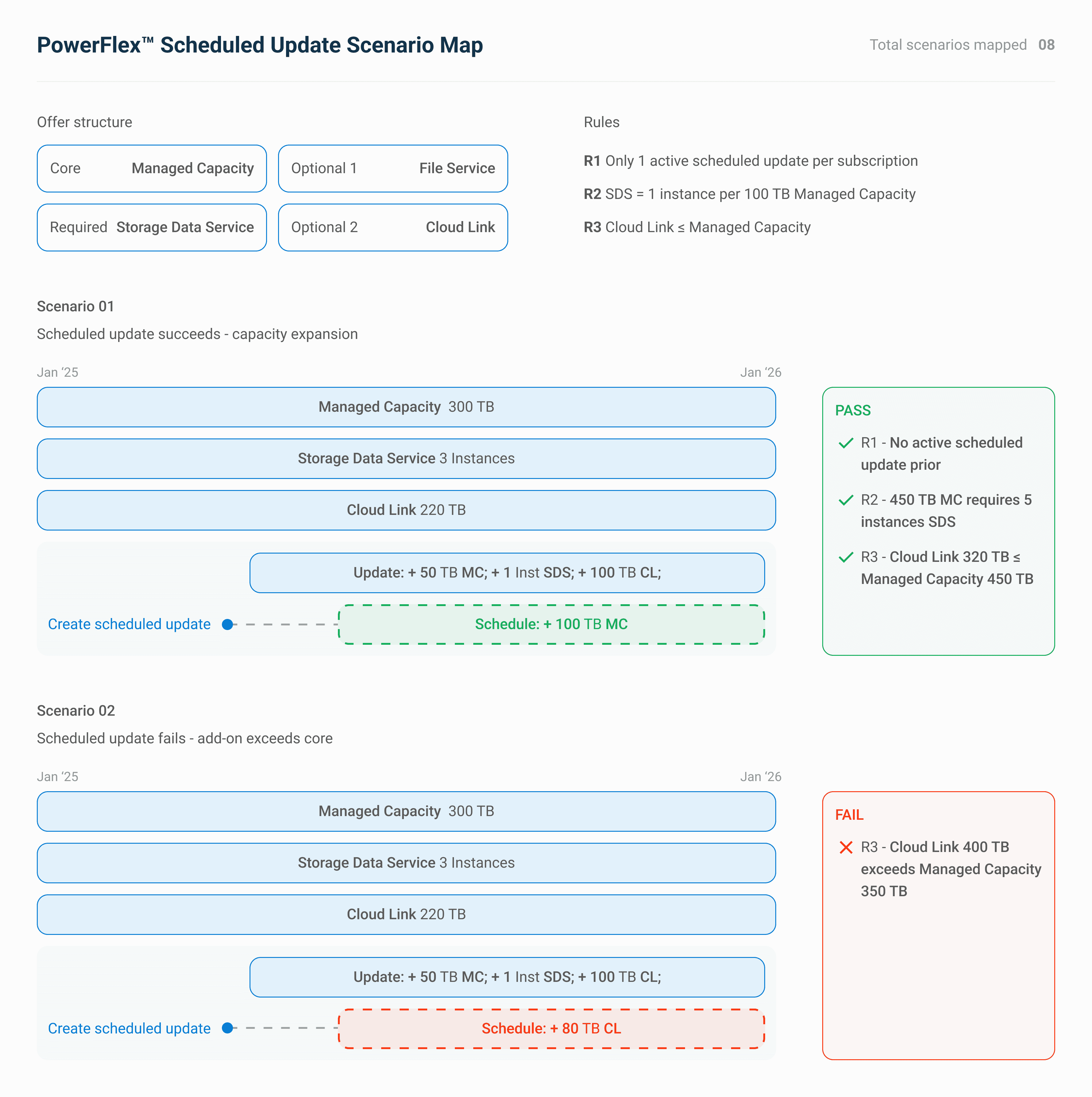
Scenario mapping I produced before implementation - used by engineering as a technical reference for the scheduled change logic.
sku-full-design
Design
Designing and testing the flow
With the logic mapped, I designed the full mid-term configuration experience: selecting what to change, configuring quantities and components, reviewing pricing with validation, and submitting the order.
Two UserTesting.com findings reshaped the flow:
Finding 1 - Users needed comparison, not just confirmation. My initial designs showed only the updated subscription state. Without seeing current versus updated side by side, customers weren't confident in what they were committing to. I redesigned the review step around a before-and-after pattern. The hesitation that showed up consistently in early sessions disappeared once both prices were visible.
Finding 2 - The sidebar needed to feel like full-screen. The initial design used a sidebar that filled roughly a quarter of the screen. Users rejected it - managing a subscription worth hundreds of thousands of dollars in a narrow panel didn't feel appropriate. I proposed moving to a true full-screen experience. The front-end team pushed back: technically out of scope for the timeline. The workaround: keep the sidebar, but expand it to fill 85-90% of the screen. Not the ideal solution, but it gave the decision the visual weight it deserved.
Multi-step Update Subscription flow: configuration → price review → confirmation.
sku-full-ui-screens
Callouts
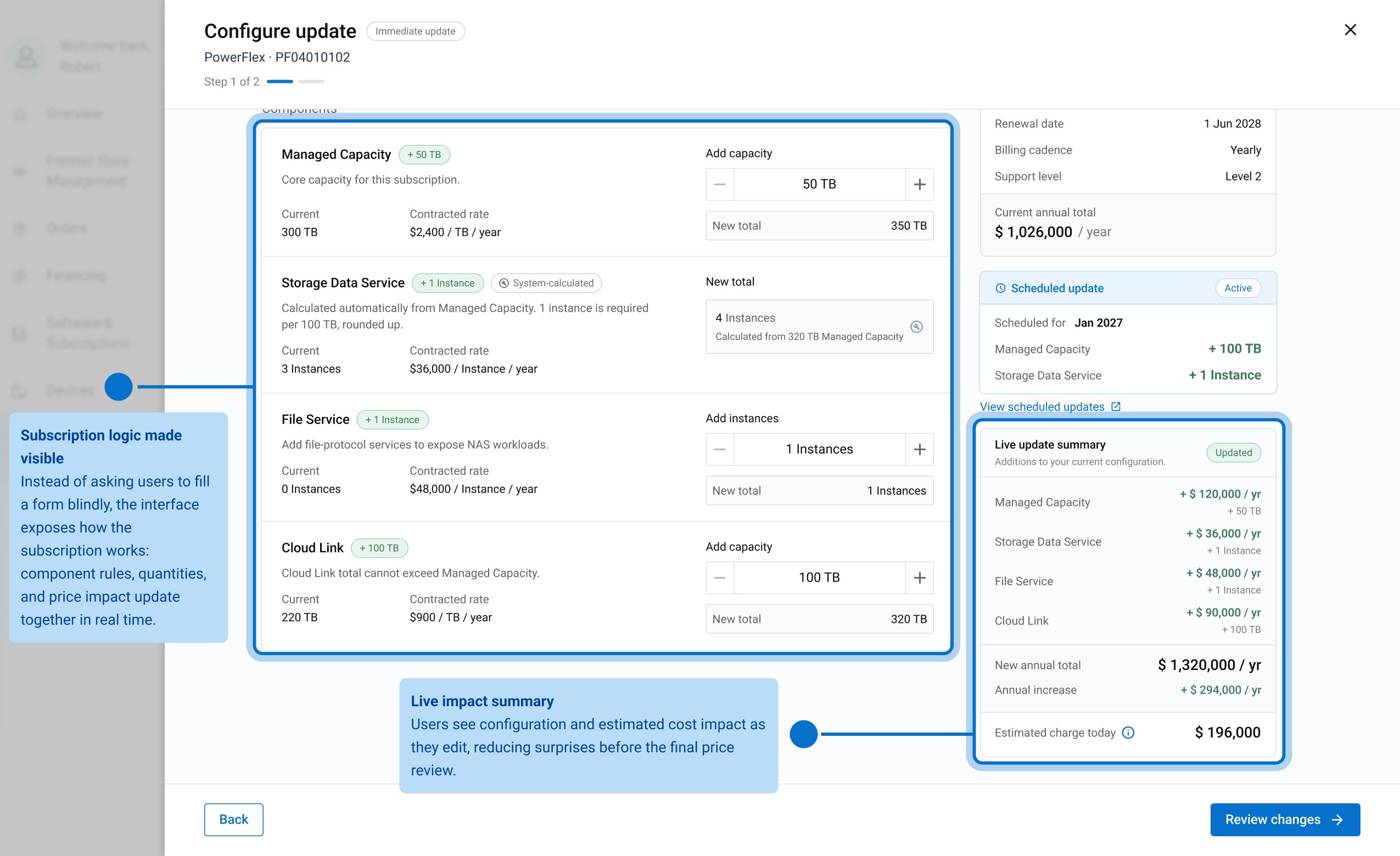
Configure step
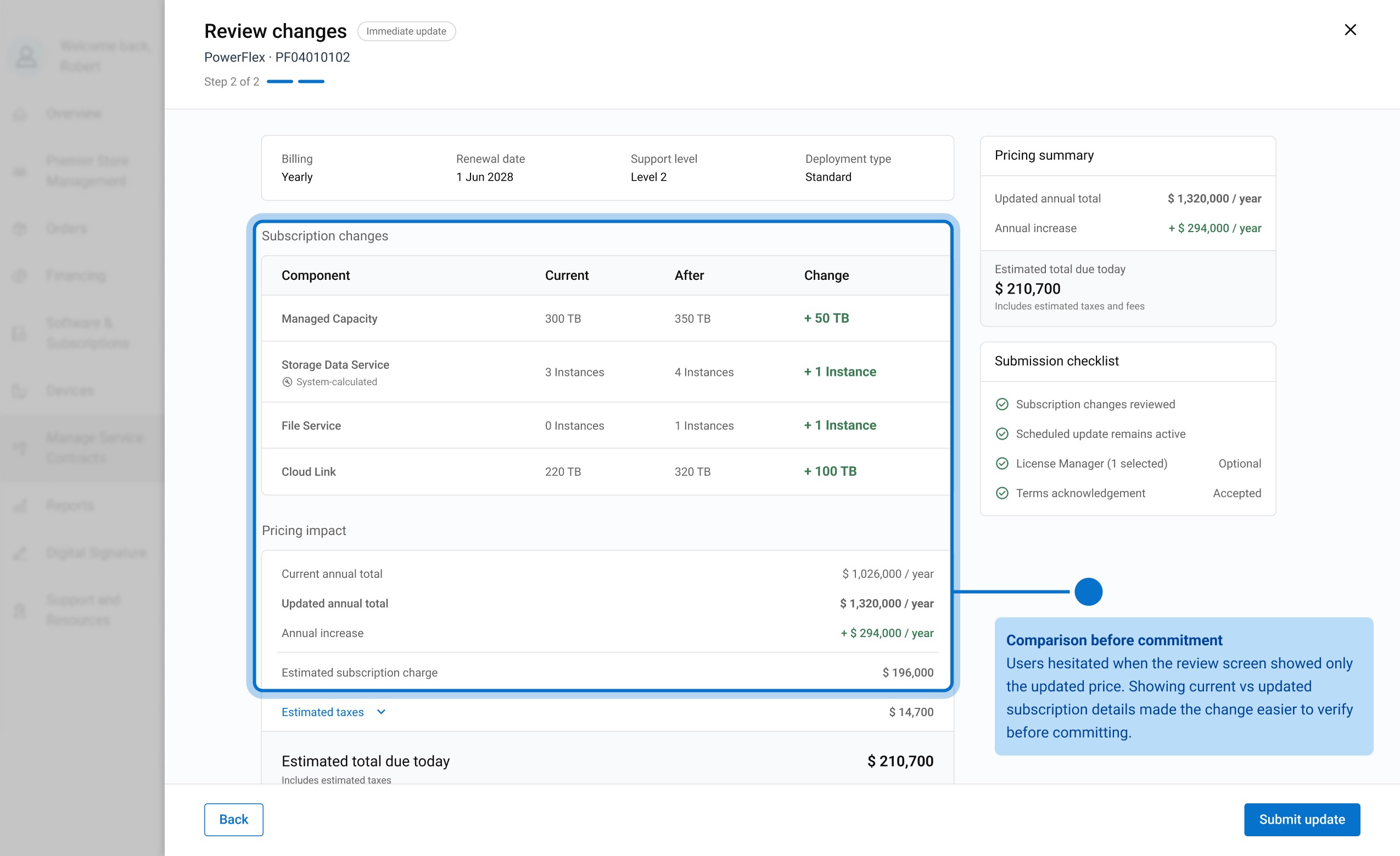
Review step
sku-full-trade-off
Trade-off
The hardest decision: License Manager
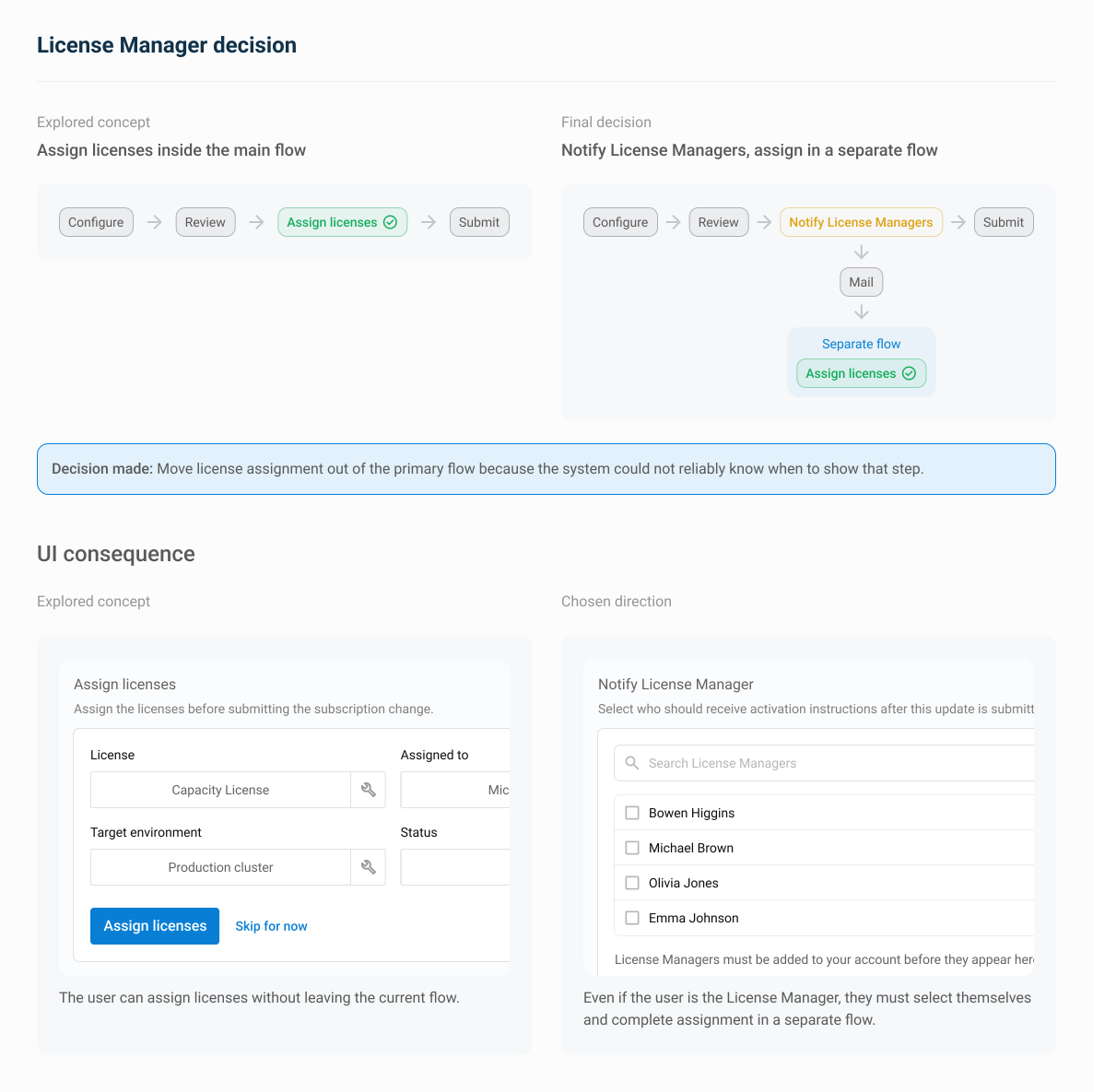
The most consequential decision was moving license assignment out of the primary flow.
Early designs included a License Manager step - the person responsible for activating licenses after a subscription update.
Research surfaced a problem:
70% have a dedicated License Manager; 30% have a Procurement Manager who also holds the License Manager role
The system had no way to detect which structure a given business had
The decision: keep the main flow clean. Handle license assignment as a separate flow. It was the right call given the system constraints.
My view then and now: the shipped flow handles the 70% case well - the Procurement Manager designates a License Manager from their team, and assignment completes in a separate flow. What it doesn't handle cleanly is the 30% case: customers where the Procurement Manager is also the License Manager. Those users have to select themselves in the flow, receive a notification email, and then re-enter as a License Manager to complete what could have been a single task. The better solution would have been an optional "assign licenses now" step for combined-role users - present for those who need it, invisible for those who don't.
sku-full-impact
Impact
Outcomes
Achieved
Time to complete a mid-term, multicomponent subscription change moved from 5-7 business days (direct flow) and 1-2 weeks (partner flow) to 6-11 minutes - measured through sales rep ticket data, customer interviews, observed workflows, and real-world sessions conducted in client offices.
Self-service adoption for this workflow moved from 0% to confirmed targets met across Phase 1 (US and Canada, small businesses) and the Phase 2 partner scenario.
Design finding
UserTesting identified a consistent drop-off at the price review step. Users shown only the updated subscription price hesitated before committing to a change. Adding the current price alongside the updated price for direct comparison resolved the hesitation in subsequent sessions. This became the before/after comparison pattern used across the flow.
Operational signal
Post-launch complaint patterns shifted from waiting time to fulfillment issues - indicating the core operational bottleneck this project addressed was resolved.
First ever
Offer ID-based offers on Dell Premier
DDVE and PowerFlex shipped as the platform's first fully digital, self-serve subscription management experience.
Case study
Highlights