
Designing Dell's Content Ecosystem
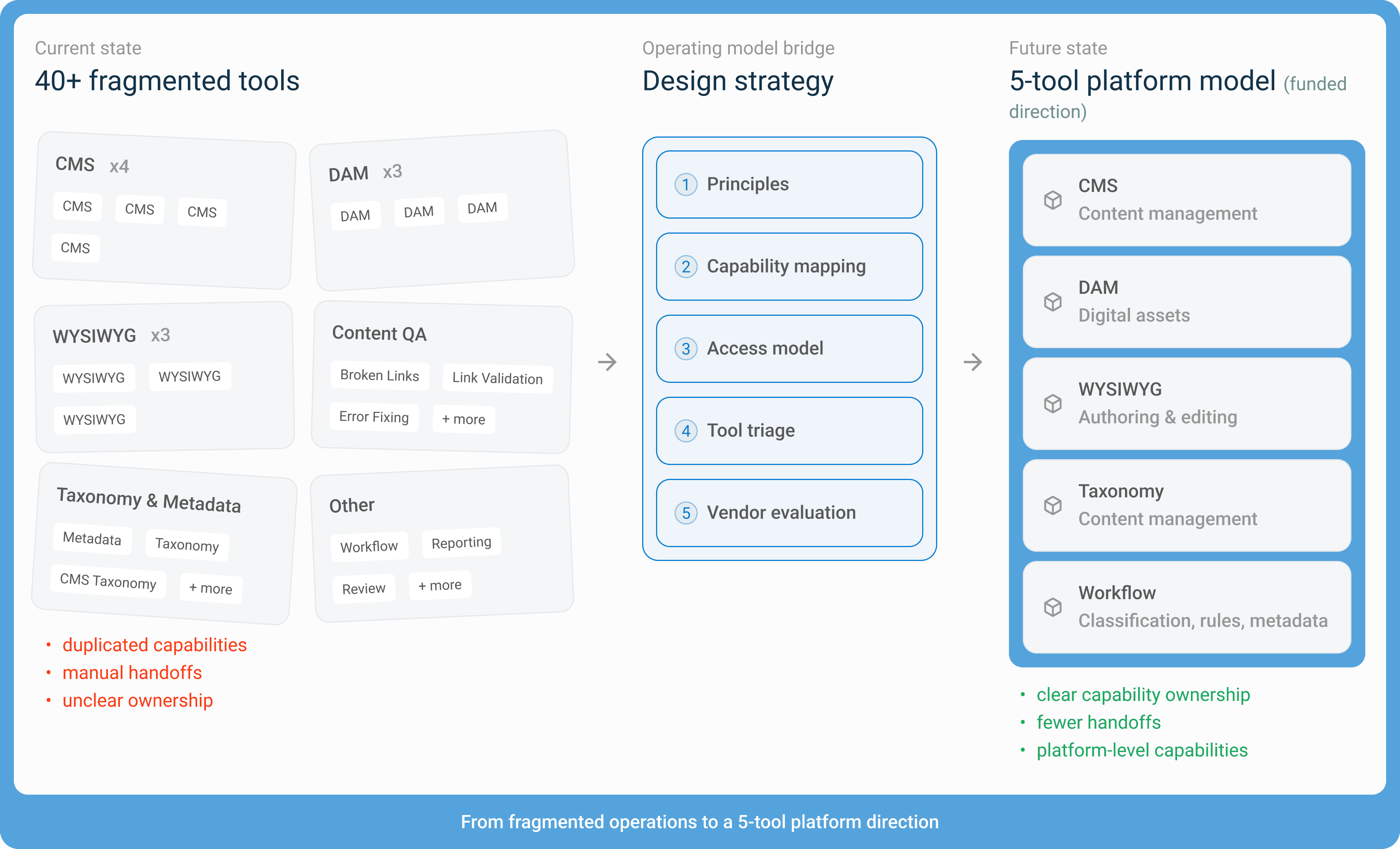
Dell's content operations ran on 40+ fragmented tools, manual workflows, and no shared operating model. I led platform UX strategy for the Content lane within COPS - establishing principles, defining the operating model, and building the artifacts that helped move a fragmented ecosystem toward a funded 5-tool future state.
Problem
40+ tools, unclear ownership, and teams dependent on multiple intermediary Ops teams to complete basic tasks. The measured cycle-time baseline was approximately 2 months.
Outcome
Funded platform direction. Final vendor selected. 5-tool future state moved into implementation. Tools touched per task: 3 → 1 in confirmed workflows. 3 operating principles adopted across the entire COPS program.
Role
Senior UX Designer / Design Lead — Platform UX Strategy, Content lane within COPS.
Timeline
2024 Q3 to 2026 Q1
content-ecosystem-full-tldr
Overview
TL;DR
The problem
• 40+ fragmented tools, manual handoffs, no shared operating model • Teams needed multiple intermediary Ops teams for even basic tasks • Two homegrown tools assumed evolvable - investigation proved they weren't
What I owned
• 3 north-star principles - defined, adopted across COPS • RBAC/ABAC strategy - access as platform capability, not org chart copy • Capability specs for DAM, CMS, and WYSIWYG • Tool triage and phased modernization across 12+ tool paths • Vendor evaluation framework - 3 PoCs, 55 testers, 100+ capabilities, 5 weeks
The impact
• Funded platform direction - estimated $80M–$120M cost-saving opportunity • Final vendor selected, 5-tool future state in implementation • Tools touched per task: 3 → 1 in confirmed workflows
content-ecosystem-full-boxes(x3)
Numbers
Tool consolidation
40+ → 5
Fragmented tools moved toward a funded 5-tool future state with clearer capability ownership.
Task simplification
3 → 1
Tools touched per task in confirmed workflows after bringing key content actions into the new WYSIWYG experience.
Estimated opportunity
$80M–$120M
Estimated cost-saving opportunity scoped by Dell’s financial team. Not realized savings.
content-ecosystem-full-team
Role
My role across the Content lane
The Content lane sat within COPS - covering Content, Offer, Price, and Store. Design was led by a Design Director overseeing CMX and a Sr. Lead Principal UX Architect overseeing COPS. I was the lead/senior designer for Content, supported by a mid-level designer and shared researcher and process engineer. Two End-to-End Leads owned the lane direction on the business side.
Rather than being embedded with one product team, I worked across all Content lane teams at program level - shaping the platform direction all of them would eventually build toward.
content-ecosystem-full-pivot
Pivot
The conversation that changed the direction
The Director of the CMX program asked me directly: could the two main homegrown tools - MAPEX and CRAFT - be evolved to serve future needs?
My answer: I'm not sure. Let me find out.
Three to four weeks later, I had five concrete reasons evolution wasn't viable:
MAPEX was built to edit existing content only - it couldn't create new content
CRAFT was scoped to landing pages only - not the full content surface at Dell
CRAFT had no CMS integration - all work was manual
Both tools lacked real WYSIWYG, drag-and-drop, and inline editing - changes happened in a drawer, hidden from page context
The future requirement was one tool that could create and edit any content at Dell, integrated with CMS and DAM, pluggable across COPS lanes - technically, architecturally, and financially impossible to reach by evolving either
His response: then we buy. My question: can we? The answer: yes. That exchange reframed everything.
content-ecosystem-full-workflow
Workflow
One routine task exposed the platform problem
The strategic case was clear. One observed workflow made it concrete - and became the test case for the platform direction.
A DAM Ops manager flagged that assets were hard to organize and search. Using 5 Whys, I traced the root cause to the editing workflow itself.
The operator: Content Ops - responsible for updating assets on live pages.
The task: Change an image on a page. One of the most routine content actions possible.
The friction: The WYSIWYG tool didn't support asset editing. The operator couldn't make the change in the tool they were already working in.
Every iteration created a new DAM entry. The DAM wasn't disorganized because of poor governance - it was disorganized because the workflow forced version multiplication for every minor edit.
I asked the WYSIWYG Ops team to walk me through a live asset change. The loop was confirmed: WYSIWYG → Photoshop → DAM. Three tools, every time, for a single editing action.
Confirmed after-state: The newer WYSIWYG flow brought asset editing in-tool and handled versioning and metadata natively. Tools touched per task moved from 3 to 1.

content-ecosystem-full-principles
Principles
Three principles for the future operating model
The investigation revealed patterns that repeated across the ecosystem. I extracted 3 principles from those patterns and from the failures we had made. They became the leading principles for Content and were adopted across the entire COPS program.
Modularity and pluggability Build once, plug anywhere across COPS. The proof: WYSIWYG inline editing built in Content was later plugged directly into the Store experience in the Buyer & Seller case study.
Decisions closer to the final state Decision makers shouldn't need chains of intermediary Ops teams to act. One image selection shouldn't require Content Ops, Photoshop, a DAM team, and a workflow handoff.
Reduce tools per job The image editing loop was the clearest example - five tools for one task. The target: fewer tools, cleaner handoffs, less duplication.
content-ecosystem-full-access
Access
RBAC/ABAC as a platform capability
I defined access control as a platform capability - not a copy of the current org chart.
In the current state, permissions were tied to how teams were organized today - meaning any future platform would inherit the same handoffs, gaps, and ownership confusion. I defined RBAC/ABAC based on workflow responsibilities and capability ownership, independent of org structure. The model was adopted across multiple COPS lanes.
content-ecosystem-full-artifacts
Artifacts
From vision to tactics
Working from the current-state ecosystem map produced by the process engineer, I built the artifacts that moved the program from analysis to decision:
Content Lane Vision - scope, problem framing, desired outcomes. Approved by E2E leads, aligned with COPS by Sr. Lead Principal UX Architect.
Capability specs - requirements for DAM, CMS, and WYSIWYG at platform level.
Tool triage and phased modernization - short-, mid-, and long-term direction across 12+ paths: consolidate, retire, reposition, replace.
Cross-lane reuse demonstration - showed how content capabilities plug into other COPS lanes, making the business case for Principle 1 concrete.
content-ecosystem-full-evaluation
Evaluation
Turning 55 testers into a vendor decision
When three CMS vendors entered proof-of-concept testing, the harder problem was that stakeholders were judging options through today's workflows - risking selecting the vendor that best fit the legacy ecosystem, not the future operating model.
I designed a 4-step evaluation system. The core shift: three Yes/No questions anchored to the future operating model, enterprise scale, and manual work or risk automatically translated into vendor-independent priority weights across 100+ capabilities. Roadmap promises couldn't receive enterprise-ready ratings. Heavy customization was capped at 3 of 5. Since 55 testers covered different capability groups, I used percentage satisfaction by group - not raw averages - to keep results comparable despite uneven coverage.
Output: a single traceable readout leadership could trust to make a high-stakes decision in 5 weeks.
content-ecosystem-full-impact
Impact
What changed, what moved forward, and what remained a target
Achieved
Tools touched per task: 3 → 1 in confirmed workflows
Dependency on 3–4 intermediary Ops teams reduced
3 north-star principles defined and adopted across COPS
RBAC/ABAC defined as reusable platform capability
3 vendors evaluated across 55 testers and 100+ capabilities in 5 weeks - final vendor selected
Platform direction
Funded platform direction - 5-tool future state in implementation
Target (post broader rollout)
Cycle time: ~2 months → ~1 week
Estimated
$80M–$120M cost-saving opportunity - scoped by Dell's financial team. Not realized savings.
Case study
Highlights